Sunday, June 10, 2007


Mt. Kilimanjaro: Day 3


Day three saw our first real taste of life at altitude. Anne felt it almost as soon as we left camp but was generally fine once we slowed our pace a bit. The scenery also transitioned from scattered shrubs, flowers and lichens to almost nothing but rocks. Anne commented that as we got higher and higher, the cover for bathroom breaks on the trail got fewer and smaller. Luckily, this coincided with all of us getting comfortable with each other. This was accompanied by more talk of bodily functions.

I was also starting to feel like the summit was very achievable. Seeing the summit from our first camp made it look distant, stormy and intimidating. This continued on day 2 but by the time we got to Shira Camp on Day 2 it seemed approachable. Like a reasonable day hike... something it probably would be if it were 15,000 fett lower. After lunch we hiked up to Lava Tower at 15,200 feet for an hour of acclimatizing before descending to our next camp at 12,600 feet. Lava Tower is at the base of the summit peak so by the time we got there the summit felt very close. It feels like you could just walk up the last hill and be there by dusk but there was still another 4000 feet above us and with it a dramatic change in how your body feels. But where we were at Lava Tower, we could all feel the altitude but it was very manageable... you just feel slightly off.
After an hour we started down to Baranco Camp. A steep but manageable trail with new sights and vegetation along the way. As we got down into the Baranco Valley, I got my first sight of the Baranco Wall... our starting point for the next day's hike. This was what I was most worried about leading up to the trip. The guidebook described it as very steep and cliff like. I don't mind steep or high but what makes me nervous is being in a situation where one slip up means death. The few times I've been in this situation (Half Dome in Yosemite and a canyon hike in the Grand Canyon come to mind) I've always marveled at how much of it is a mental game. If the physical challenge were 6 inches off the ground you wouldn't give it a second thought. But take that very same challenge and put it 70 feet up and it feels completely different. Fortunately, the majority of Baranco Wall is not like this. As I got my first site of the wall, I could see that although it was steep and high it also had enough of a slant that you would rarely be on the edge of a cliff. My intimidation subsided and I was ready for the next day's challenge.

Anne's nausea had been getting better steadily as we descended and she was now feeling pretty good. There was another trail across the ravine and on it we could see Cyndi and another guide. Cyndi had been throwing up all morning and was having a tough time. After lunch she decided that she couldn't continue and headed directly to camp via another trail. Although we had continued climbing after lunch and had sat around for an hour, we were still getting into camp around the same time as Cyndi. The two keys to a successful Kilimanjaro ascent are water and a slow pace. Lose the benefit of either one and your health diminishes quickly. Being sick makes you lose water and then makes it hard to drink so it quickly becomes a losing battle at altitude. The next morning, Cyndi and Jonas, our lead guide made the decision that she needed to hike out. I don't know if a helicopter rescue is possible at that altitude but short of a life and death situation, you are forced to hike out on your own. She was accompanied by one of our guides and a mountain ranger... one in front of her and one behind her. That morning, as we were doing our scramble up the Baranco Wall, Cyndi was essentially descending it. Going down a steep cliff is usually harder and scarier than going up one. Doing it while you're weak, dizzy and dehydrated must have been really tough!

Sleeping well at 12,600 feet would normally be a problem. But after going up to 15,200 and then descending to camp, your body feels better. So we all slept well that night. Many of us woke up feeling the best we'd felt since we started (except poor Cyndi). We were ready for the Baranco Wall.

Saturday, June 09, 2007


Mt. Kilimanjaro, Day 2

The second day was my favorite day on the mountain. We started out at 10,000 feet and hiked to 12,600 feet… our shortest hike of the 6 days and with breath-taking scenery the whole way. We started out at the forest’s edge in the Moreland zone and made our way into the Heather zone defined by smaller, moss covered trees and eventually just shrubs. We had lunch at a great spot and the weather was pleasantly warm all day. But the real treat was coming into the beautiful Shira Camp while it was still warm and with several hours of daylight left. The sun was shining and it was warm enough to walk around in sandals (the last time I wore them until we were down.


As we came into camp, there were 4 porters hanging out on some rocks singing a song about Kilimanjaro in perfect four-part harmony. It was beautiful even though they mainly seemed to be doing it to relax and pass the time. I was glad to see that they get some downtime too after seeing them carry everything they do for two days.

Shira camp is also beautiful because the views up and down are beautiful. You have a clear view of the summit looking up and the clouds that had partially covered it when we arrived kept clearing until the peak was unobstructed. Looking downward, you see Shira Cathedral, the camp’s namesake. The Shira ridge used to be as tall as Kibo Peak (the name of Kilimanjaro’s Summit). The glaciers used to end close to Shira Ridge, 1000s of feet below where they are now. Day 2 was a dream all around. The hiking was beautiful and not that strenuous and the camp was one of those places that makes camping so amazing. Even though we were already above 12,000 feet, we wouldn't start to feel the altitude until Day 3.

Friday, June 08, 2007


Mt. Kilimanjaro; Day 1


Day 1 started at the Kigongoni Lodge in Arusha where we had our briefing the night before. The lodge is located at the top of a hill with the individual bungalows scattered along the steep hillside. It was our first encounter with porters carrying our bags in what was to become a daily pattern on the mountain. But were already at a bit of altitude and as Sunny, one of the trekkers commented, "its hard to watch but not as hard as carrying them yourself."

We drove to the Machame Gate at 6000 feet, the starting point of our climb. There we signed in and handed off our bags to the mountain porters already busy loading up the rest of the supplies. We had heard the night before that there would be 45 porters supporting the 14 climbers and 6 guides but when you finally see them, the scale of the effort (and guilt) sets in. We reminded ourselves that it's good work for the porters and the returned to our more personal worries at the trek ahead.

Although we had been in Tanzania for 5 days, we had yet to have a good view of the mountain. Today was no different as there was a thick fog that had settled around the gate for the start of the trek. So, suited up in our gaters, rain shells and technical wear, we started hiking. This was also our first experience of, "Pole Pole"... "slowly" in Swahili. We had heard about it but now that were finally experiencing it first-hand we were amazed at just how slowly "pole pole" really is. Little did we know how hard it would be to do anything other than pole pole on summit day.

The truly amazing thing about the trek to the top of Mt. Kilimanjaro is that the scenery changes dramatically every day. Today, we started in a dense rain forest... full of fog and inhabited by colobus and blue monkeys. Five or six hours later, you arrive at Camp 1 just at the edge of the rain forest and the beginning of the moreland zone marked by fewer, thinner, moss covered trees and our first view of the peak high above us. From here, the top of Kilimanjaro still looked a long way off and the swirling clouds and fog gave it a stormy appearance. It was just enough to make it appear intimidating and the perfect setting to contemplate the hike ahead.

Wednesday, May 30, 2007

Getting Ready for Africa


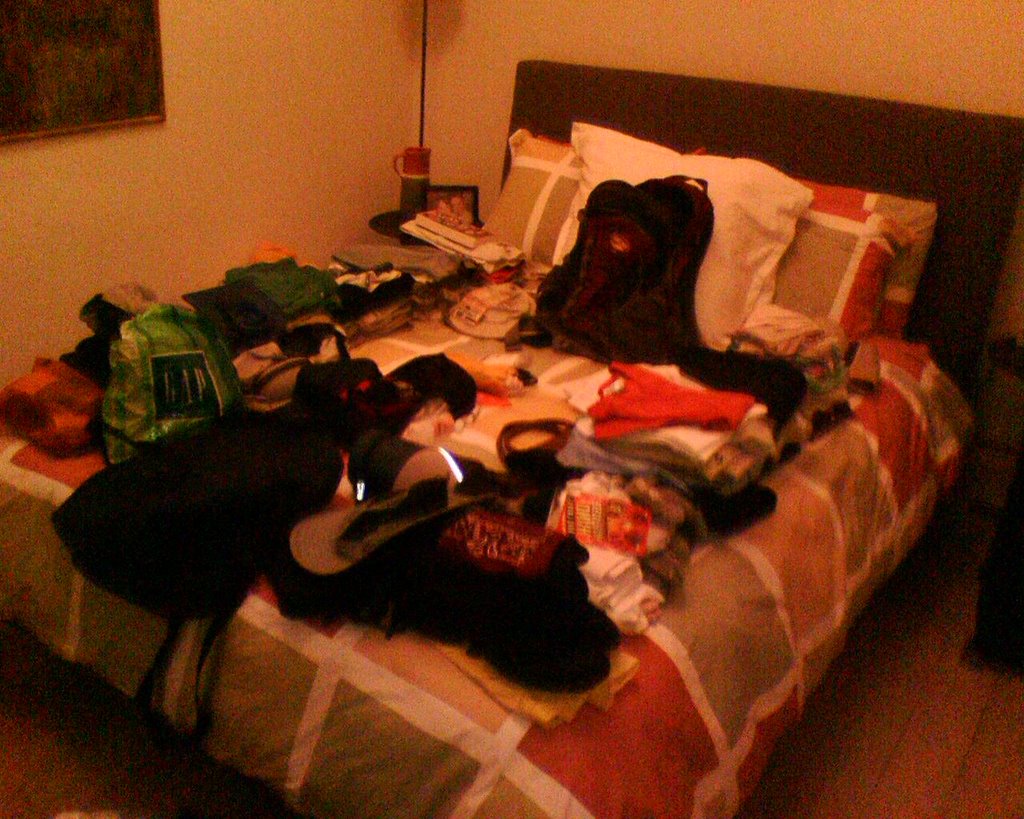
This is a picture of our guest bed covered with clothes and supplies for our trip to Africa. Instead of making me psyched it ended up making me feel guilty. We're taking the trip to find about Africa and organizations that we might be able to support with time or money. We're also climbing Mt. Kilimanjaro with a National Geographic guide and a eco-friendly guide company. We're going in part to see the effect of global warming on the glaciers of Kilimanjaro. So we're going with the best of intentions. But seeing all the clothes and gear on our bed made me feel guilty at how much energy... clothes, oil, shipping goes into getting 2 people to Africa and then up Mt. Kilimanjaro. We've joked that getting ready for the hike has become a part time job but it really is and made me think. If we put this much energy and prep into a non-technical hike up Kilimanjaro, imagine how much effort goes into prepping for Mt. Everest. It is a very selfish activity, particularly if you leave family behind who will worry about you. Your adventure becomes their concern until you're safely off the mountain.

We try to use less in our day-to-day life... we don't drive an SUV, we bought an old house instead of a new one, we take public transportation whenever possible. So maybe this is a splurge, a life experience that interupts our normally restrained lifestyle. Maybe this trip will lead to an opportunity for Anne or I to make a more positive impact on the World and it will end up offsetting any negative impact of all this oil we are personally consuming to get there.

We'll see

Sunday, May 27, 2007

View from Mt. Diablo Summit


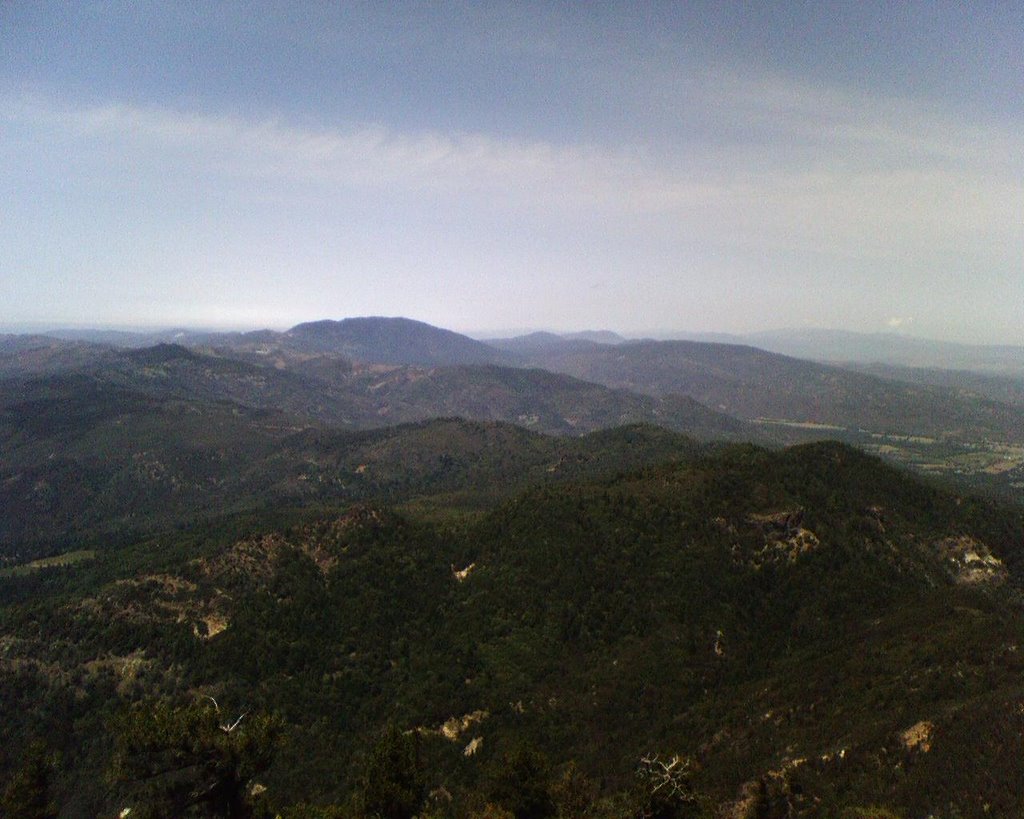
Looking East from the top of Mt. Diablo. We're half-way through our last training hike before leaving for Africa. 3 hours to the top but lots of nice views on the way up.

Sunday, May 13, 2007

Mount St. Helena from Mayacamas Ridge


This is a view of the mountain from the opposing ridge that separates Napa and Sonoma. It was taken just off Petrified Forest Road where we stopped to check out Mayacamas Ranch. After a 2 hour hike up into the canyon at Bothe-Napa State Park, we stopped for some serious barbecue at Buster's on the edge of Calistoga. Its almost embrarassing to say but we spent the whole weekend in wine country and didn't stop at a single winery. We actually drove around the heart of Napa to get to Calistoga to save driving time. Although we enjoy showing Wine Country off when we have visitors we just didn't feel the pull this time. Our one nod to Wine Country was doing a flight of wine at dinner. There is something unspoiled about Calistoga that we really enjoy. The town is small and has a striking mountain ridge (the South flank of Mt. St. Helena) that dominates the view down Main Street. It makes Calistoga feel more like a mountain town than a part of Wine Country.

Saturday, May 12, 2007

View from Mt. St. Helena


This is the view from the top of Mt. St. Helena (not to be confused with the more famous, Mt. St Helens in Oregon). Mt. St. Helena sits at the top of Napa Valley and despite being the tallest mountain in the Bay Area is not very well known. If you're looking to do all 4300 feet of it, you might be out of luck because the main route to the top starts in Robert Louis Stevenson State Park about 200 feet up the mountain. The view from the top is nice in all directions but that's because you're not looking at the mountain itself which is non-descript and covered with radio towers on multiple scattered hilltops. There are almost no trails on the mountain. All ascents are made via a single fire road which branches out at the top to the North and West Peaks. The hike is just OK... a good workout but thats about it.

Wednesday, February 28, 2007

Conduct Unbecoming


Senator McCain is a Republican. But his biggest strength has always been his integrity and his honesty in voicing his views wherever they fall in the political spectrum.

I'm a Democrat. Until recently, I had been thinking that I could see voting for him as President specifically for the above reasons. I believed that his integrity would lead him to make the right decisions regardless of its level of support by his own party. I saw in him the potential to heal the Red State/Blue State divide that has created so many problems. He stood to get my vote because of his integrity not his party affiliation.

There is a great scene in the movie "Flags of Our Fathers" where John McCain's father visits West Point to check up on how his son is doing. He finds out that he is not doing so well academically but seems disinterested. He then inquires whether the younger McCain has done anything dishonorable... anything that would be considered "conduct unbecoming of an officer." Although this is of less interest to the academic, he says that McCain has conducted himself with integrity. His father makes it clear that this is all that matters and leaves. It is this integrity of character that clearly defines the rest of the movie and McCain's behavior in real life.

But in the last few months, he has lost a bit of this integrity. He has been slowly but steadily shifting opinion on a number of core political issues. All of it appears to be aimed at shoring up support from Bush's core constincuency... the religious right and political conservatives. But it is exactly this move that is making him far less attractive to me. So in an effort to get the support of people in his own party he is losing the support of people on the Democratic side of the fence. By changing his true colors, perhaps for the first time in his life, he is losing support from people like me who have always admired him for being so true.

Saturday, February 10, 2007

The art of war


Interesting winning photo by Spencer Platt in this year's World Press Photo Contest. It spurred me on to look at some of the other winners. Viewing the photographs gave me the uncomfortable feeling of how beautiful war and despair can be in the hands of top photographers. It reminded me of the images of Edward Burtynsky that I first saw at the TED conference in 2005. Having gone to architecture school in Buffalo, NY and in the shadows of the steel industry, I have always found industrial architecture aesthetically interesting. Burtynsky takes that aesthetic appeal to a whole new level with his large format, crisply lit images of the fringes of our industrial world. In his photographs, the cast offs and decaying stages of heavy industry look somehow more beautiful than "healthy" and thriving industrial scenes. It takes time to understand what you're looking at. You first enjoy its aesthetic beauty and then start to decode what you are looking at. Over time, you realize that while the images are quite beautiful, the workers who appear in them are real victims... often of the same industries that bring oil, tires, minerals and plastic toys to the USA each and every day.

Friday, January 05, 2007

Fanfare: Yes, Common Man: No


I just watched Arnold Schwarzenegger walk out on stage as part of his swearing in ceremony. He hobbled out on crutches to the tune of Aaron Copland's "Fanfare for the Common Man". I've heard Fanfare many times but never in place of a US state's equivelant of "Hail to the Chief". It was very strange. When I hear "Fanfare for the Common Man" I think of the dawn of human civilization, grass roots organizations and stories of average men and women accomplishing something amazing. I don't think of a highly staged event where some larger than life Hollywood celebrity walks out to the applause of thousands of his party supporters with news cameras flashing. As beautiful as the song is, the combination with "Arnold" makes it seem out of tune.

Thursday, November 02, 2006

Trust but clarify


In the Cold War era, the US and Russia eventually agreed to reducing their stockpiles of nuclear weapons. The agreeements included a "trust but verify" policy where each side allowed the other to witness or monitor the dismantling of weapons. It seems to me that we need a similar policy for George Bush's statements about the War on Terror. Bush said again today that, "the US does not engage in torture". But it has become clear that we do. In a separate interview with Scott Hennen, Cheney today confirmed that the CIA used waterboarding techniques on captured senior Al Qaeda suspects.

George W Bush's preferred communication style is the "truthiness" approach (otherwise known as lying). This allows the party faithful to go on believing even when the facts say otherwise. I think the press and US citizens should demand a "trust but clarify" policy where unclear statements made by the president and his administration must be verified so that there is no more truthiness... only truth or lies.

With friends like these...


I couldn't believe the news this morning about John Kerry's bungled joke about education and the Iraq War. I'm not sure it would have been funny even if he hadn't bungled it. He told the joke while giving a campaign speach for Phil Angelides. Angelides has almost certainly lost the election against Arnold already but Kerry's joke sealed his fate. In a skit on The Daily Show, Jon Stewart and company were mocking the fact that the Democrats are ahead in the polls despite having no coherent strategy. There was a mock TV ad for a democratic candidate that literally featured no message. After seeing Kerry's botched joke on the news, I couldn't help thinking, we could probably win this thing if John Kerry would just shut the f@*k up.

Saturday, October 21, 2006

Dusk Falls at the BSB

This is looking west out of the Shoreline Amphitheater... the sun setting and the perimeter lights backlighting the wandering crowd. The view looked interesting but the low-res Sidekick photo makes it look almost mysterious.

on "the grass" @ the Bridge School Benefit

The crowd chillin at Neil Young's Bridge School Benefit concert. Gillian Welch is on stage who, despite her comments that they play, "downer acoustic rock" is jammin with some great guitar riffs. Its shaping up to be a great night... Dave Mathews, Pearl Jam, the Foo Fighters and more Neil still to come.

Tuesday, October 17, 2006

Saying is believing


When the Mark Foley scandal hit, the hypocrisy of the Republican Party finally became clear to many formerly firm believers. What was truly amazing was not that Mark Foley was gay, or that he was initiating inappropriate relationships with teenage boys or that his fellow Republicans attempted to cover it up. What surprised me the most was that he was leading a committee charged with protecting children while trying to have sex with exactly the underage boys he was supposed to be protecting. It seems like the low-hanging fruit for him would have been to at least resign this committee.

What I often find frustrating about the Republicans is that what they say and what they believe are often two different things. Only in the Republican Party will you find a gay man going against gay rights. This is not the case with the Democrats. You can even find straight Democrats who support gay rights because while not gay themselves, they believe in gay rights. I don't believe that all these Republicans are so against the gay community. I don't believe that all of them are as religious as they say they are. I can believe that most Republicans (like Democrats) think abortion is unfortunate and to be avoided if at all possible. But I don't believe that all these Republicans think abortion should be illegal knowing that many poor women would be forced to seek secret and often dangerous alternatives. And I wonder if all the Republicans who say they are religious believe that invading Iraq was the right thing to do now that over 600,000 Iraqis have been killed. Is it right to be a deeply religious person and still believe that all this killing is what God would want us to do?

It seems to me that a Republican will say whatever they need to say to win the vote. Not only are they good at this gaming of the political process but they are also good at uniting on which issues are key. Democrats seem to be on-the-whole, much truer to their beliefs. What they say matches what they really believe. You would think this would be an easy recipe for success... spawning passionate candidates who easily beat Republicans feigning their beliefs. But the inividual passions of all these Democrats results in a 1000 issues being raised against the 8 - 10 the Republicans consistently rally around.

In the last six months, many heartfelt Republican issues have finally been exposed as political strategies and not deeply held convictions. Issues like, "We're winning the Iraq War", Bush's true feelings about religious conservatives, Mark Foley's concern for the security of our youth, and the motivation behind the Healthy Forests Act. Hopefully this will be the undoing of several incumbant Republicans running for re-election. Then, all we have to worry about is getting the Democratic party to recognize that we can't take on all the issues at once. And we need to make it clear that when we take on an issue, we really believe in it. You don't have to be saying you are the morally superior party to be it... you just have to believe.

Friday, October 06, 2006

Interview with Frank Rich

This is a good interview with Frank Rich, author of, The "Greatest Story Ever Sold: The Decline and Fall of Truth from 9/11 to Katrina."

Until a few years ago, Frank Rich was the lead Broadway Theater Critic for the New York Times. What's interesting about his switch to a serious political writer is its relevance to the Bush Administration's approach to the truth. He makes the case that the way Bush has tried to manipulate the truth is very similar to staging a theater production with one thing being acted out on stage while a completely different truth is going on back stage.

Sunday, April 30, 2006

Symmetrical Diplomacy


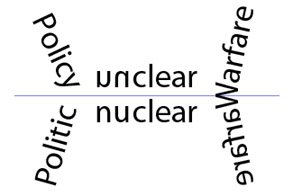
Given a flawed blueprint, nature will sometimes use symmetry as a stand in. I learned this at a lecture by Greg Lynn on mutations in nature. One of his observations was that organisms attempt to create features even when they lack a complete instruction set. Lynn showed several examples of symmetrical mutations including a human hand with two mirrored thumbs. What initially appeared as just a random deformity now had a logical (albeit flawed) reasoning. Over the last year, as I have read story after story on Bush’s strategy for fighting terrorism, it reminded me of Lynn’s talk. In many ways, Bush is behaving like a mutation of American policy. In the absence of a rational blueprint, he is slowly and steadily resorting to symmetry as his instruction set for international policy.

Symmetry as a concept is not new to international policy. For years, the Pentagon has labeled the battle techniques used by terrorists as “asymmetrical warfare”. It was mentioned frequently in the wake of 9/11 and is a classic example of egocentric military thinking. The assumptions embodied in the term are absurd when you break them down. Asymmetry refers to the techniques, scope and technologies employed between two military opponents. Our preferred style of military engagement, the “shock & awe” approach, involves aircraft carriers, fighter jets, nuclear submarines, the best radar systems in the World, tanks, and the highly coordinated efforts of large ground forces. Their approach involves small, independent cells of fighters initiating small-scale attacks with homemade weapons. Asymmetrical warfare implies that the enemy has chosen not to engage us on a similar scale… as if they had a choice! I suspect that the Pentagon has finally stopped using the term because there is no other country capable of engaging us in symmetrical warfare. Symmetry also implies a kind of aesthetic judgment… as if two opposing symmetrical militaries was the only proper way to fight. You can almost hear the British Generals in the Revolutionary War complaining that the Minutemen did not know how to stand up and fight like gentlemen.

Symmetry as a policy for international diplomacy also has its problems. The Geneva Convention attempts to minimize the horrors of war by asking all nations to adhere to certain policies and restrictions. Things like civil treatment of prisoners, avoiding the killing of innocent civilians, and refusing to use chemical and biological weapons. When adhered to evenly by nations at war, the policy benefits everybody. The problem arises when so-called “non-state actors” like Al Qaeda engage in warfare since killing innocent civilians is core to their military strategy. They were never asked nor are they interested in signing the treaty. Given its focus only on recognized nations, the Geneva Convention starts to become an asymmetrical policy that favors Al Qaeda over participating countries. In this situation, what should the US do?

Alberto Gonzalez called the Geneva Convention, “quaint.” We remain a signer, but our day-to-day actions seem to be mirroring rather than countering the tactics of our enemies Al Qaeda and Saddam Hussein. We invaded Iraq because we said Saddam Hussein had used chemical weapons and might be preparing to use them again. President Bush said that someone who would consider such diabolical behavior should be removed from power. But few Americans know that America employed chemical weapons during the battle of Falujah inside Iraq. We denied it until we were faced with clear evidence to the contrary and finally admitted to it. How can we justify using the very technique we are seeking to eliminate?

We have said that Saddam Hussein killed innocent civilians, imprisoned suspected militants without due process and engaged in torture. Again a policy that is antithetical to the principals the US was founded on. The policies remain ours of record but not action. We put captured Al Qaeda militants in Guantanemo to avoid due process rules and then proceeded to treat them inhumanely. By putting captured Iraqi insurgents in the Abu Graib Prison and then torturing them, we have literally followed in Saddam Hussein’s footsteps. Again, we denied doing it until the pictures came out to prove it. New pictures have recently surfaced that confirm the behavior continues.

In perhaps the biggest example of hypocrisy yet, we have been considering using our nuclear weapons to stop other countries from making their own. The original stated reason for invading Iraq was to rid them of their WMDs. We continue to condemn Iran and North Korea for seeking to develop nuclear weapons. But we do so as the World’s second largest possessor of nuclear weapons. The average American hopes we never use another nuclear weapon. But under Dick Cheney and Donald Rumsfeld’s direction, we debated the use of small-scale nuclear weapons in Afghanistan and Iraq in order to penetrate under-ground bunkers. In Iran, we are again considering using our nuclear weapons to destroy their nuclear weapons facilities. I don’t know if this is ironic or shameful. So far, reason has prevailed but to have even considered it as part of our public discourse is highly hypocritical.

In all of these examples it appears that the US policy has moved from one that lives by the ideals set by our founding fathers to one that mirrors the policies of those that we oppose and detest. The average American still believes that the USA is a good country and in their own personal lives, most Americans are. But as Americans, we also have to take responsibility for the actions of those we put into power. There has been much discussion on the relationship between Al Qaeda and Islam. Moderates in the Middle East and here agree that it is not the religion but the few radical Islamic fundamentalists that are causing the problems. Our hope in Afghanistan, Iraq and now Iran is that the moderates will rise up and overcome this radical minority. Isn’t it time for the moderates of this country to rise up and get us back on the right course.

As a designer, it’s always interesting to see design terms used to describe something else. In design, symmetry is still used today for everything from wallpaper to typographic layouts. But one thing is always true about symmetry in design. It’s only worth copying something if you find the original beautiful and worth repeating. Al Qaeda is not the aesthetic choice.

Saturday, October 15, 2005

I just bought the soundtrack to "No Direction Home" Martin Scorsese's new documentary about Bob Dylan. Anne and I watched the documentary on PBS and found it funny, insightful and amazing. The unfolding of Bob Dylan's life from a small town in Minneapolis to the voice of post WWII youth is incredible. Dylan says early in the film, "I wasn’t born where I was supposed to be so I've been trying to find my way back home." It is an amazing story of transformation and Scorsese does a masterful job curating great archival footage into a portrait of Dylan’s early years.

Bob Dylan's own comments are brief and in keeping with his cynical approach to the media throughout his career. Lucky for us, a close friend of Dylan seems to have convinced him that he needs to start talking because his life and music are too important for him to remain silent. Sharing his feelings comes hard to Dylan. This leads to some of the humorous moments in the film… whether it is being difficult with the press or, more recently, when he starts to own up to being cryptic.

It seems as though throughout his life, his only consistent effort to promote his ever-changing mystique was to not promote it and not answer questions about it. In some of Dylan's interviews he acts like an adolescent interacting with his parents… saying as little as possible, making faces, not even agreeing with them when they happen to agree. The closest he comes is a slight smirk as if to say, "I know you’ve got a point, I know I’m being difficult but I’m still not going to meet you half way." Somehow, over time, this becomes an appropriate response to the many fans and media that confront him about the deeper meaning of his lyrics. He consistently responds that they are just songs and he a simple "song and dance man".

Early in the documentary, Dylan indicates that although he was enrolled at the University of Minnesota, he didn’t attend classes. Instead, he spent his time going to clubs and studying every piece of folk music he could get his hands on. Dylan even subtly admits to stealing a bunch of records from a casual friend. Bob Dylan became a student of music and got his bachelors, masters and PHD from the school of Woody Guthrie and many others. He studied the masters, copied them, thanked them, and then moved on to become "Dylan" a singer and songwriter like no other. It is an amazing story of both the poet and cultural icon. The soundtrack and DVD are worth a close listen.

Friday, October 14, 2005


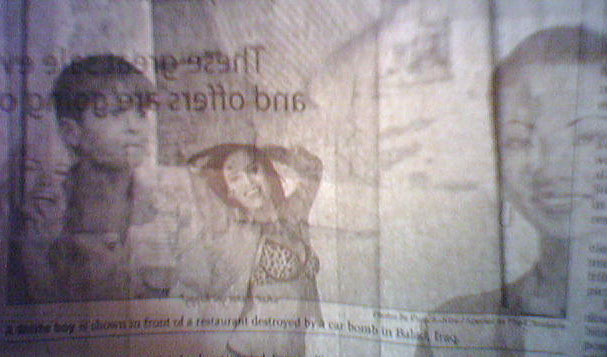
I was reading the newspaper this morning. As I turned to the last page of the section and started reading a story about the war in Iraq, this is what I saw. The image is the result of the Macy's underwear ad on the back "bleeding" through to the image of the Iraqi boy on the front. While it is unplanned, it doesn't seem completely random. It seems representative of the mix of commercial and media images we see everyday in the US. Its all a competition for our attention and I think too often, the commercial world wins. Posted by Picasa

Monday, October 10, 2005

Dining Alfresco

Californians love to dine outside. It makes total sense in Southern CA but it can be a bit of a stretch here in San Francisco. This is a shot of the new Cafe @ the Beach Chalet at Ocean Beach. Its a bit like a small-scale version of the Bryant Park Cafe behind the Public Library in NYC. The interior is casual but well designed and the cafe opens up onto the yard behand the chalet. Service was very slow but had it been warm, we wouldn't have minded. But we had biked there in shorts and as the sun ducked behind the building, it started to feel more like the Ski Chalet.

Like many other SF restaurants, they roll out the portable heaters as the sun goes down which softens the chill slightly. The cold was total deja-vu since we had dined outside just the night before at the wedding of a good friend in Napa. The location and table settings were absolutely beautiful but as the sun went down, the chill came. As the night wore on, the men got more dressy and the women donned shawls if the had them. A few who were more prepared walked around in evening dresses with serious winter coats over the top. I guess it is one of our time-honored traditions... like watching 4th of July Fireworks through the fog. Beautiful in their own way (just make sure you're properly dressed).